Saturday, August 28, 2010

Toyota Enviro Outreach 2010 DNA Barcode Project launched


Although the Toyota Enviro Outreach never really sleeps, the 2010 project was officially launched at the University of Johannesburg (UJ) - home of one of the Outreach’s partners - on Wednesday 25 August 2010, four weeks prior to the start of the expedition. The purpose of the event was to get the team together for the first time and due to the size (the biggest yet on an Outreach) to explain the what, why, how, where and when of the project.

While the Outreach’s main aim in 2009 was to assist the South African Wildlife College with field work in neighbouring countries, Professor Michelle van der Bank of the UJ and Olivier Maurin, one of her PhD students, joined the expedition to do DNA Barcoding on trees. With 2010 being the international year of biodiversity and with Michelle being the custodian of the South African leg of the international Barcode of Life project, the subject of the environmental assistance of the Outreach for this year was a natural choice. DNA Barcoding of as many species as possible (the aim is set at 1 500) in the three South African biodiversity hotspots (see attached map) will be assimilated during the three week expedition. In fact the Outreach will be assisting the DNA Barcoding project for the next three years.

If you think the Outreach consists of bundu bashing through the bushes of Africa, think again. Especially if you look at scientists and intelligentsia making up this year’s team. No less than 17 specialists will have to be accommodated, fed, transported and looked after by the Klipbokkop logistical team. Not to mention the scientific infrastructure and equipment the Toyotas will have to carry. Samples need to be treated with delicacy and must be packed and treated in a specific way to ensure the DNA data is not lost or damaged. For example, any succulent sample needs to be frozen immediately to ensure true results.

After a brilliant presentation by Michelle to put everyone in the picture, the team started talking, asking questions and getting the DNA juices going. Almost to the effect that they nearly missed the scrumptious lunch offered by UJ. Thanks Michelle that will be the last meal you’ll have to worry about for the Outreach. Gerhard and Elmarie Groenewald and their team will ensure that everyone is well fed, sheltered and transported from 20 September to 6 October.

The table is set. The clock is ticking. Follow the progress of the Outreach on this blog, on facebook, twitter and there will also be a great article in My Tyd, the magazine inside Rapport on 5 September.

Wednesday, August 18, 2010

The Plant DNA Barcoding Project


The Goal
Our goal is simple (but important) to have a complete database of DNA barcodes for all South Africa’s plant species. This database will allow scientists in the future to be able to identify plants by matching the DNA barcodes of plants that they collect to that of plants that are already in the database.

What will we collect?
Basically every plant that we will encounter during the 17-day fieldtrip but priority will be given to indigenous and endemic flowering plants. At least three individuals/plants from different localities will be sampled for genetic studies. We will pick a couple of young leaves per plant and then dried it in silica gel for DNA studies. We will also prepare two herbarium vouchers. In other words a piece of the plant (with flowers and/or fruits) will be pressed in a plant press and dried in an oven for identification and storage in the herbarium (one voucher will be kept at UJ and the other will be sent to a national herbarium in South Africa).

The Team:
We have an ambitious well experience team mostly consisting of researcher and postgraduate students from UJ. Masha Kuzmina from the Biodiversity Institute of Ontario, Canada will join the plant barcoding team. UJ have a long working relationship with Masha starting back in 2008: first with the Kruger Park Project and later on with TreeBOL Africa. The plant collecting team will consist of Olivier, Michelle & Masha. Solome will be in charge of the back-up team at Klipbokkop (Mark, Ledile, Bruce and Jephris). They will have the important job of sorting samples, preparing herbarium specimens and putting leaves into silica as samples come back
from the field.


Wednesday, July 21, 2010

Press Release : Uncovering South Africa’s Natural Riches

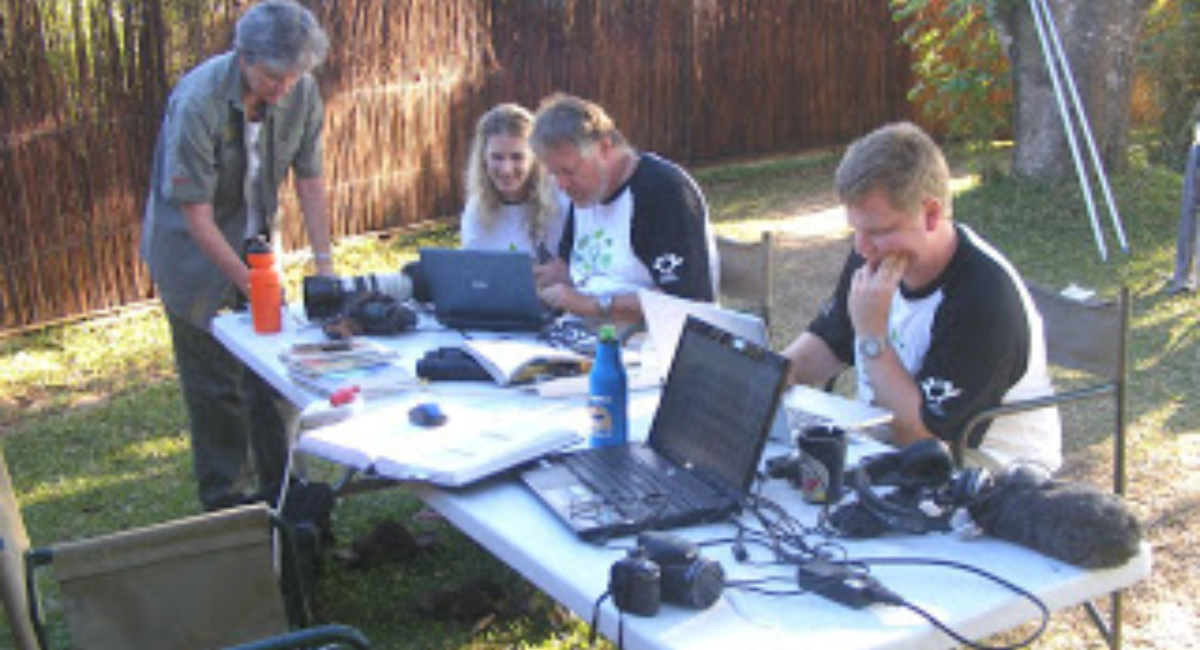
Training staff at Klipbokkop Mountain Reserve with Dr. Maurin from University of Johannesburg in preparation for DNA sampling on the Toyota Enviro Outreach


Building extra plant presses to accommodation the samples to be collected during the Enviro Outreach

2010 Toyota Enviro Outreach and International Barcode of Life will document life in biodiversity hotspots

A fleet of Toyota (10 Toyota Hilux pickups) carrying South African and Canadian researchers will set out from the University of Johannesburg September 20 on a 17-day expedition to document South Africa’s animal and plant species.

Although South Africa’s biodiversity is a priceless resource, vital to human well-being and planetary health, scientists have still not catalogued most species. For instance, 50,000 species of insects have been recorded but an estimated 50,000 more have yet to be described.

In an attempt to bridge this gap, the Toyota Enviro Outreach Team (under the expert guidance of Gerhard and Elmarie Groenewald from Klipbokkop Mountain Reserve) together with scientists and students from the University of Johannesburg, University of Guelph (Canada), Cape Nature and SANPARKS will mark the International Year of Biodiversity with a 17-day expedition to collect plant and animal specimens for DNA barcoding.

This project, which aims to safeguard our natural wealth and reduce biodiversity loss, is part of an effort called the International Barcode of Life (iBOL) project, the biggest biodiversity genomics initiative every undertaken. Led by a team of Canadian scientists, the project’s goal is to to assemble a DNA barcode reference library for all life on Earth.

DNA barcoding utilizes sequence diversity in a standardized gene region to identify species and discover new ones. Because this technique works on minute amounts of tissue, it can even be used on fragments of plant and animal material that would be difficult to identify using traditional morphological methods.

South Africa has undertaken to barcode 20,000 specimens by April 2011 and a further 40,000 specimens by April 2013. The benefits of this ambitious work program will be enormous. Applications of the DNA barcode identification system include curbing the illegal trade of endangered species, controlling pests and vectors of disease, identifying invasive and poisonous organisms, as well as fragmentary material in forensic investigations. However, the main application will be to assess species diversity in the world’s biodiversity hotspots where a shortage of specialist skills hampers conservation efforts.

The Toyota Enviro Outreach initiative will start on September 21 at the Klipbokkop Mountain Reserve and will run until October 5. During their travels, the research team will work in three of the world’s 34 global biodiversity hotspots – the Succulent Karoo, the Cape Floristic Region and Maputaland-Pondoland-Albany.

The goal is to collect specimens from a broad range of taxa and to produce DNA barcode records for all of them. These barcode sequences will be uploaded on the Barcode of Life Data Systems (BOLD), an online informatics platform where they will become part of a growing reference library of DNA barcodes for South African plants and animals that is freely available for use by the broader scientific and amateur naturalist communities.

All voucher specimens will be deposited in major national collections where they will be available for examination and in-depth analyses by researchers. The project will also expand the electronic information base on South African biodiversity and facilitate the growth of the National Collecting Programme.

“The importance of South Africa to the iBOL initiative cannot be overstated,” said Paul Hebert, the Scientific Director of the iBOL Consortium. “From the iBOL perspective, it is the ideal combination – a country with vast biodiversity and a community of skilled scientists dedicated to the application of DNA barcoding in species identification”.

“We are immensely grateful to the Toyota Enviro Outreach initiative for its assistance in ensuring that South Africa achieves its barcoding targets.”

According to Prof Kinta Burger, the Dean of Science at the University of Johannesburg, with this expedition, Toyota provides the African Centre for DNA Barcoding at the University of Johannesburg together with its partner institutions the unique opportunity to collect research samples from parts of Africa that are normally inaccessible.

Additional note to Editors:

The International Barcode of Life (iBOL) project is a Canadian-led research alliance, which spans 26 countries and brings together hundreds of leading scientists in the task of collecting specimens, obtaining their DNA barcode records and building an informatics platform to store and share the information for use in species identification and discovery. By 2015, iBOL participants will gather DNA barcode records for five million specimens representing 500,000 species, delivering a highly effective identification system for species commonly encountered by humanity and laying the foundation for subsequent progress towards a barcode reference library for all life.